Important inflation updates in the US and Australia this week. Both central banks appropriately now focused on upside inflation risks from AI spending boom. RBA Minutes to continue to warn of the risk of further interest rate rises.
Key points
- Overall, I remain modestly bearish on Australian and US fixed income due to AI-driven inflation and assess that the risk of moderate further tightening of US and Australian monetary policy before Christmas remains underpriced by markets.
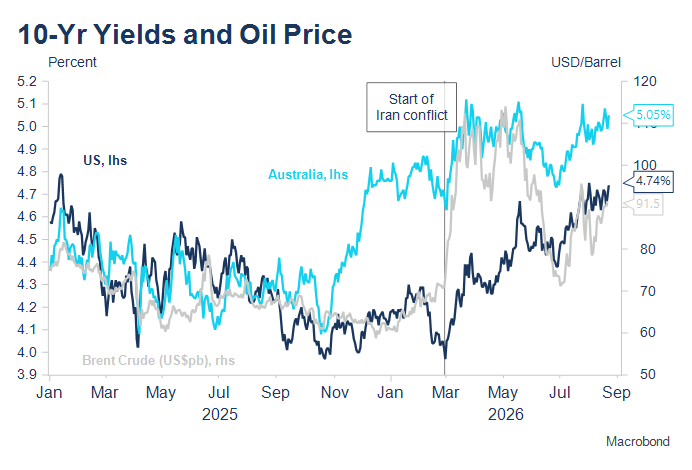
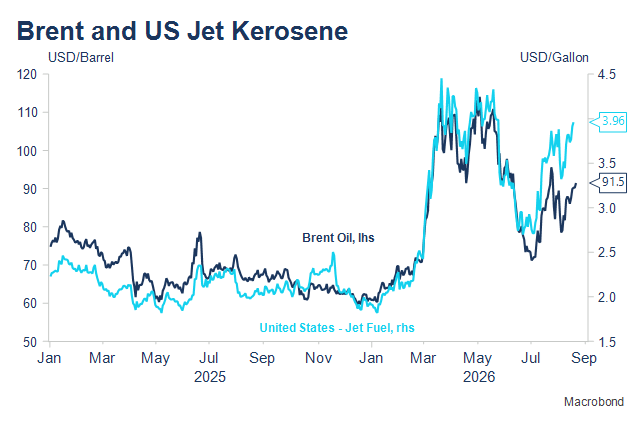
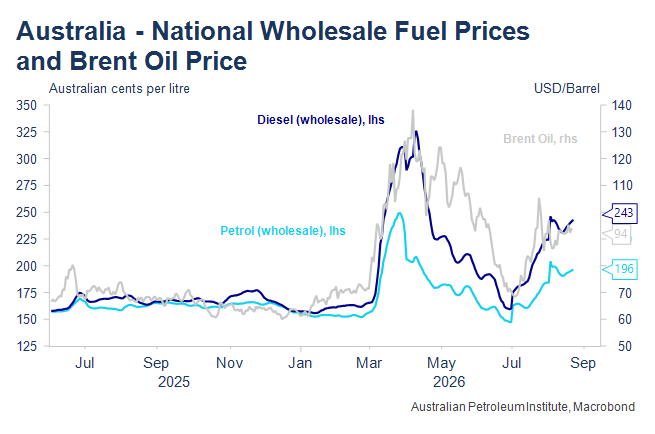
- Oil, petrol, diesel and jet fuel prices all rose again in the past week, with diesel and jet fuel prices having recorded larger increases in recent weeks. This will pressure inflation readings in August and raises the risk that price increases spread more broadly through supply chains. There seems to have been very little progress toward a solution to the Iran conflict in recent weeks.
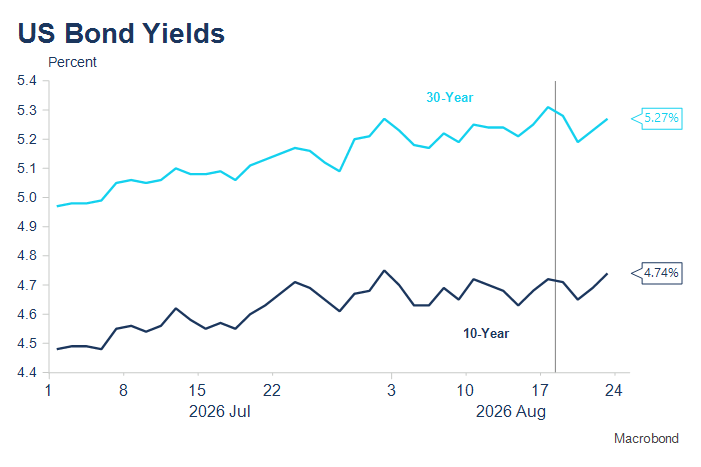
- The rise in longer-dated US yields seems to be causing some concern at the US Treasury. Secretary Bessent attempted to lower long bond yields with an increased buy back announcement last week. This was broadly unsuccessful – as intervention against fundamentals almost always is. The bond market continues to be driven by strong competition for capital from AI investment and government spending, along with demand-related AI inflation concerns, higher oil prices and uncertainty about the Fed’s willingness to tighten.
- My assessment is that the Australian labour market data was largely insignificant for markets: employment had grown strongly the previous month, there was only a very minor change in unemployment, while a significant difference in the characteristics of the incoming survey sample of the population further reduced the importance of the release.
- This week in Australia, the RBA Minutes, July CPI and Household Spending Indicator are in focus. The Minutes will provide detail about the case to raise interest rates further, which was considered but unanimously rejected by the Board at the August meeting. The main reason is the Board is awaiting further information on the impact of prior tightening. That is likely to be available by the November Board Meeting. The core CPI is expected to remain elevated at around 0.35% m/m – there seems to be greater upside risks to both Australian and US inflation in August. Australian analysts nonetheless in my opinion have been premature to assume there is little pass through from the Iran conflict into inflation, given petrol and diesel prices were artificially lowered by the government’s fuel subsidy.
- In the US, it’s the PCE and Fed Chair Warsh at Jackson Hole. As in Australia, there seems more upside risk to the CPI in August, though the risk on the July PCE also seems on the upside of the market’s 0.2% m/m prediction, given last month’s very low outcome. The latter was driven by some category movements which seem likely to reverse.
- Jackson Hole has often proven to be a significant event for markets and US monetary policy, with former Chair Powell using the speech to signal shifts in the Fed’s thinking. That seems very unlikely given Chair Warsh’s espousal of no forward guidance, preferring markets to do their own analysis. The speech is likely to focus on taskforce topics including thoughts on Fed communications, inflation measurement, the balance sheet and AI spending. This may cause the market to add some further risk premium into longer-dated yields. I think Warsh’s message is reasonably clear: analyse the data. The Fed will set monetary policy on the basis of developments in the data.
- Finally, it was interesting in both the FOMC Minutes and RBA Deputy Governor Hauser’s fireside chat last week to see both central banks thinking a lot more about AI spending and potential short-term inflationary consequences. That remains the key reason why I continue to assess that further monetary tightening is likely in both Australia and the US and why no early interest rate reductions are likely in Australia.
What’s priced in…
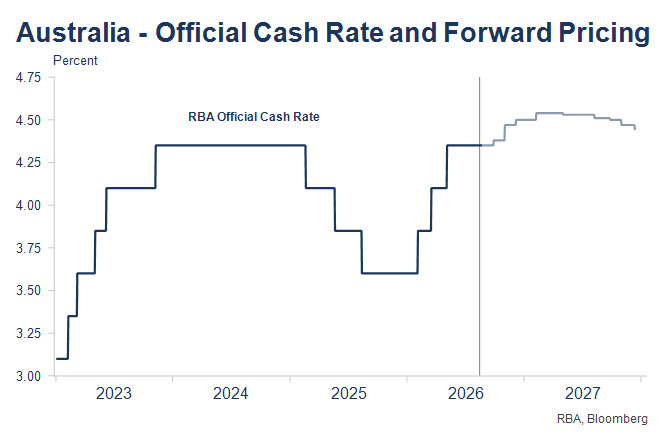
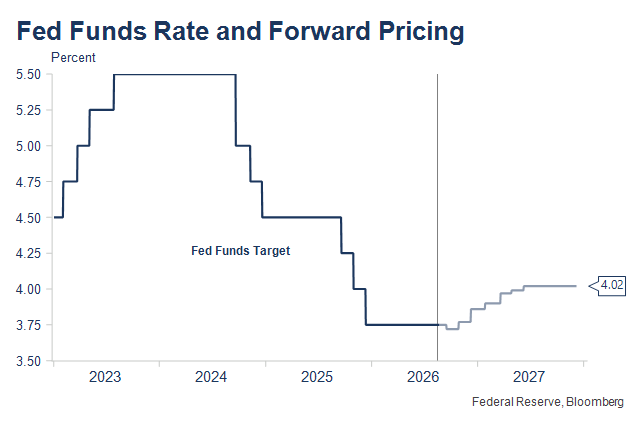
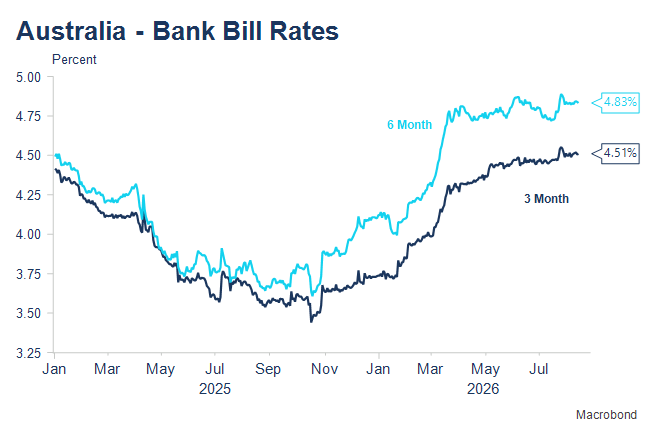
The past week has seen a continued reduction in market pricing for future interest rate movements by both the RBA and Federal Reserve. Now, there is only a 75% chance attributed to one further 25bps rate rise by the RBA by the February meeting next year, with only a 60% chance of a move by Christmas. In the US, where of course there has been no move to re-tighten policy, markets continue to discount some modest firming of policy over the next year and a half. However, now there is slightly less than one tightening priced by Christmas and the peak cash rate discounted implies just over one and a half 25bps rate rises by the Fed.
Central scenario
I remain modestly bearish on both Australian and US longer-dated yields in the near-term. This chiefly reflects the expectation that the strength of AI spending – particularly in the US but also globally – will continue to support economic growth and create a number of demand-related inflationary pressures in construction, technology and selected commodities in the near-term. This will add to Iran-related pressures on oil prices – and in Australia to continuing faster than consistent with target wages growth – to keep inflation elevated at above-target rates. This in turn will require moderately firmer policy from both the Federal Reserve and the RBA to return inflation to target, something that remains under-priced by interest rate markets. Longer term, I remain concerned that AI may cause significant job losses, which would be supportive of lower interest rates, but that is more a medium-term story.
Key developments over the past week
There were four key developments over the past week affecting Australian interest rate markets:
- Oil prices continued to rise as the stalemate in the Middle East showed few signs of progress. Perhaps more importantly, the prices of diesel and jet fuel have risen considerably: in rough terms, oil prices are up around 50% since pre-Iran. Petrol prices are currently around 26% higher, diesel +44% and jet fuel +89%. The risk of these renewed increases being built into supply chains rises the longer there is no resolution to the conflict and shipping remains disrupted through the Strait of Hormuz. It seems analysts in Australia have been quick to assume the recent somewhat lower inflation outcomes in both countries mean the inflation threat has passed. That conclusion seems premature as Australian government subsidies and previous optimism of an Iran solution temporarily reduced prices.
- US Treasury Secretary Bessent attempted to lower US longer-dated yields with an announcement of increased buyback operations for longer-dated bonds from $2bn per operation to $4bn per operation. Bessent suggested longer-dated yields were no longer reflecting the fundamentals. This announcement had a very short-lived but reasonably significant impact on yields but like much intervention, was relatively quickly reversed as the fundamentals of higher inflation, large US budget deficits and strong competition for capital from AI borrowers were of course unchanged by the announcement.
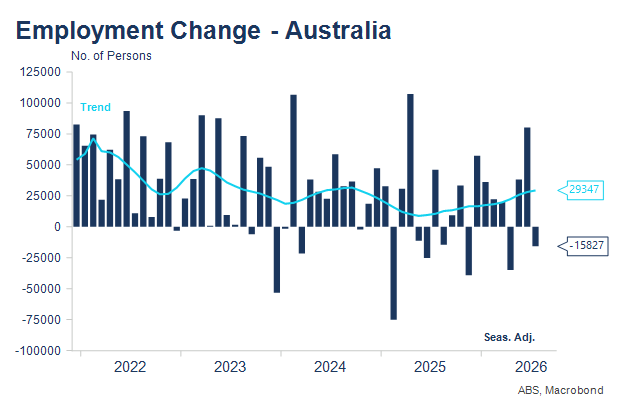
- Australian labour market data surprised to the downside, with employment falling 16,000 in July and the unemployment rate rising from 4.4% to 4.5%. The market saw this as further reducing the chances of any tightening by the RBA and reduced that pricing accordingly. However, I didn’t read the data as holding too much significance for policy. A pullback in employment was always the risk after last month’s huge increase (which was revised a little higher to +80,000), while the unemployment rate was effectively unchanged in the month, rising only from 4.43% to 4.46%. The “incoming” or new sample of the population in the survey also had a much higher unemployment rate and lower employment rate than the “continuing” sample, which further lessens the significance of the outcome.
- The July FOMC Meeting Minutes to an extent contained something for everyone, with arguments both for a continuing hold in policy and also of the need for somewhat higher interest rates. In my opinion the Fed continues to progress toward some firming of US policy. As in Australia, inflation risks were seen as to the upside (and growth and unemployment risks to the downside). Still, “Many participants anticipated that policy tightening would be required if inflation did not decline”. In addition, the Minutes noted that there had only been a relatively short period of time between the June and July meetings, not allowing significant further information on the economy. Additional information would be available by the mid-September meeting after the Northern Hemisphere returns from its summer holidays. Very interestingly, both the Fed and the RBA have been much more focused on assessing the implications of the AI investment boom on near-term inflation in recent communications. This demand-driven inflation is the key reason I continue to expect some further near-term tightening in monetary policy in Australia and the US, and no early reduction in interest rates in either country.
Australian and US key events calendar
All times shown are AEST.
Tuesday 25 August
- 11:00am $1.2bn 1% 2031 bond tender
- 11:30am RBA August Board Meeting Minutes
Wednesday 26 August
- 11:30am CPI – July (Headline expectation +0.9% m/m, 3.3% y/y; previous -0.1% m/m 3.8% y/y; trimmed mean expectation + 0.35% m/m; +3.5% y/y; previous +0.28% m/m, 3.6% y/y)
- 11:30am Construction Work Done (expectation +0.4% q/q; previous +3.4% q/q)
- 10:30pm US PCE deflator (expected +0.2% m/m/3.3% y/y; previous +0.1% m/m/3.3% y/y)
- 10:30pm US GDP Q2 (first revision – 1.5% SAAR expected (unchanged from first estimate)
Thursday 27 August
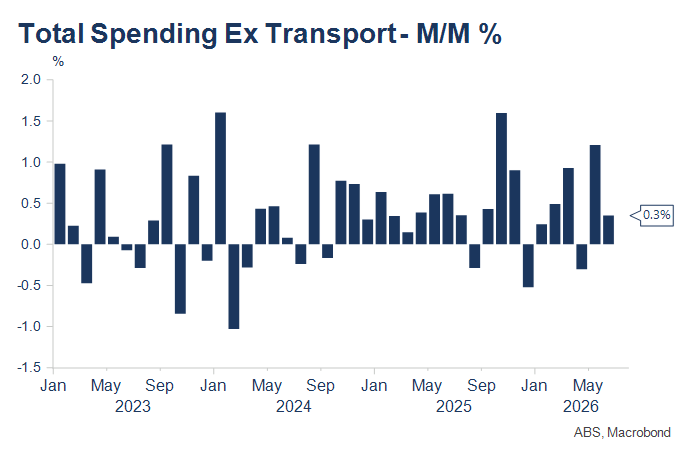
- 11:30am Household Spending Indicator – July (expected +0.3% m/m after +0.8% m/m)
- 11:30am Capital Expenditure – Q2 (expected +0.3% q/q after +6.5% q/q)
Friday 28 August
- 11:00am $800m 4.25% 2035 bond tender
- Midnight Fed Chair Warsh speaks at Jackson Hole
There is quite a bit on the Australian and US calendars this week.
In the US there are two major events – the July PCE inflation reading on Wednesday evening and Federal Reserve Chairman Kevin Warsh’s Jackson Hole speech at midnight on Friday evening.
In recent years, the Jackson Hole speech has often provided for some very significant developments for US markets and interest rate expectations. The title of Warsh’s speech won’t be released until Thursday, though the topic of the symposium this year is “Financial Innovation, Implications for Payments and Policy”. US commentators expect the Chairman to continue to provide no short-term guidance on interest rates or inflation as has been his mantra since assuming leadership of the Fed. That suggests the speech will instead focus on longer-term issues. The latter will likely include the themes of the Fed’s five taskforces currently underway, including Fed Communications, Inflation Measurement and Targeting, the Fed Balance Sheet, the impact of AI and Statistics Measurement. This could create some upward pressure on long-term yields if markets continue to fret about reduced communications from the Fed. To me it seems clear that the Chair is directing the market to analyse the data, as the Fed will be. Monetary policy will be adjusted on developments in the data.
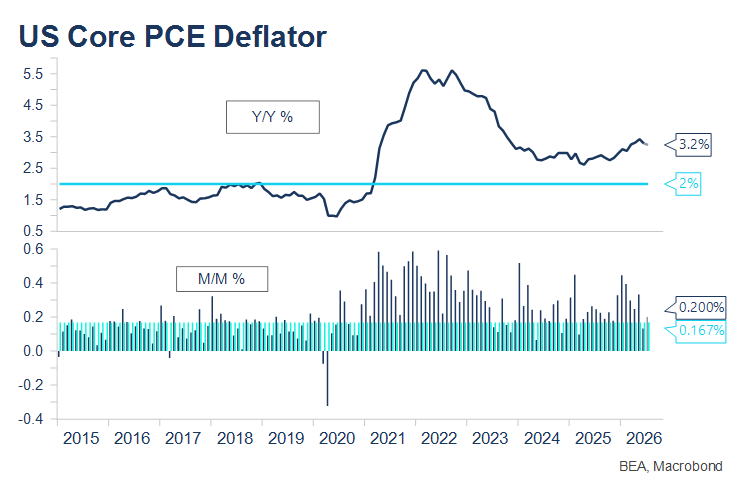
The key US statistic for the week is the latest core PCE inflation reading. After last month’s surprisingly low result, which appeared to reflect temporary weakness in a number of categories – in part due to the weaker oil prices in May and June – the risk appears to be to the high side of the market’s 0.2% m/m forecast. The risk of a high print seems larger in next month’s CPI and PCE as energy prices have risen sharply through the second half of July and across August (the same comment obviously applies to Australia also). Core PCE inflation continues to run in excess of the average 0.167% m/m outcomes required to deliver the Fed’s 2% PCE inflation target.
In Australia, the latest RBA Minutes are published along with the July CPI and Household Spending Indicator and two of the partial data inputs to Q2 GDP, the latter released the following week. I’m not a great fan of GDP as a near-term driver of markets, given how dated the GDP information is when released. I do wonder whether this quarter’s release might be more important with the RBA continuing to (mis)place what I consider excessive focus on estimates of aggregate demand and supply balance. Q1 GDP was negatively impacted by weather events, which suggests the risk of an upside surprise in Q2 as these effects reverse.
More important this week are the Minutes from the August Board Meeting two weeks ago, the monthly CPI release and the latest estimate of Household Spending.
On the Minutes, the Governor confirmed the RBA’s Monetary Policy Board discussed (but unanimously rejected) the case to increase interest rates 25bps at the August meeting. A rate rise was not considered at the June Meeting. The Minutes will spell out the cases for leaving interest rates unchanged and for tightening. Other communications around the meeting suggest the hold chiefly reflects the Board’s desire to await further indications on the impact previous tightening is having on the economy and inflation. The Board’s message remains very hawkish and warns of further tightening if there are not signs soon that growth is slowing sufficiently to return inflation to target, or that inflation prints remain too elevated for this to occur in a reasonable timeframe. Markets remain unconvinced given such a move is only 75% priced, with the big four banks all still predicting interest rates have already hit their peaks for this cycle.
I continue to assess that Australian markets are under-pricing the likelihood of further tightening, though the data and market pricing have been moving against this view in recent weeks. The median market forecast is for a drop in the annual trimmed mean inflation rate from 3.6% to 3.5% in July. This still implies a 0.35% m/m increase in July, well above the average 0.2% m/m rate broadly required to deliver 2.5% inflation.
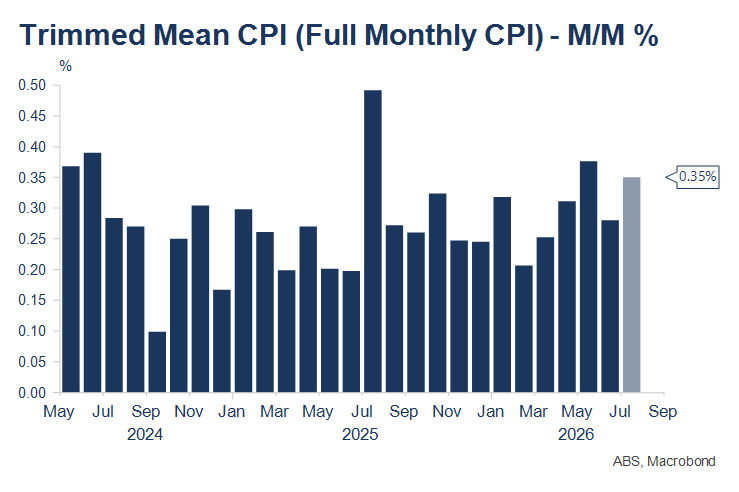
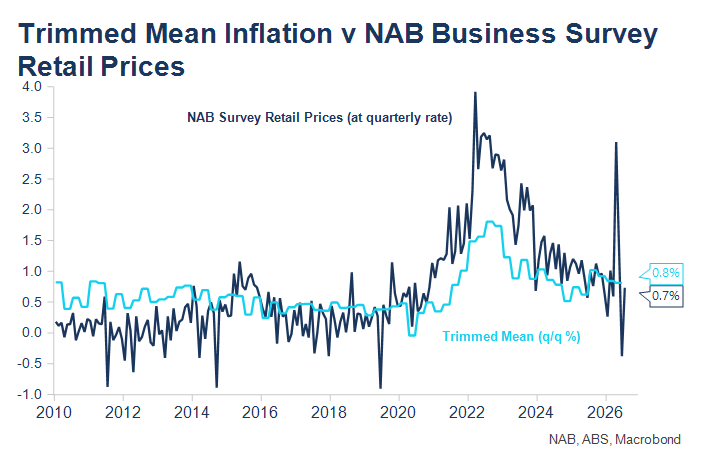
A key focus for the market will be on whether there is evidence of higher rates of inflation in some of the categories likely to be most impacted by the undesirably large minimum and award wage increases that took effect from 1 July. Remember the Fair Work Commission awarded a 4.8% wage increase based on the RBA’s forecast for inflation this financial year. The wage rise, like the renewed increase in oil prices, may be more of a factor in the August data, but the data for meals out and takeaways, food and other retail-related categories will be watched closely. My tracking of fuel prices suggests perhaps a slightly smaller rise than other forecasters for this category this month, before a very large rise next month (circa +4% in July before a 15-18% rise in August).
The Household Spending Indicator is somewhat difficult to interpret at the present time, given the significant influence of volatile petrol prices on transport spending and elevated inflation more generally affecting the data, which are quoted in nominal (or $) terms. This makes it harder to decompose the figure into real growth and inflation than when inflation is broadly stable.
The banks’ access to their customer transactions data normally means their forecasts are pretty much on the mark. This month, however, the forecasts range from NAB at +0.7% to Westpac at -0.5%, which isn’t much help. Higher petrol prices will bias spending a little higher, though I expect the conclusion of End of Financial Year spending to work more significantly in the other direction, suggesting risk of a low-side outcome this month. As in previous months, I will be looking at the aggregate excluding transport, to combat part of the volatile petrol price influence on the data, though this does not correct for the effect of somewhat higher overall inflation. A strong result is significant as it would suggest some combination of higher prices and stronger spending.